Pamela Taylor Music
  • Home
  • About
  • Classes
    • Jungle Music
    • Music is Fun
    • Junior Keys
    • Piano Keys
    • Piano Keys (Teen & Adult)
    • Private Study
  • Videos
  • Testimonials
  • FAQ
  • Blog
  • Contact

Uncategorized

No Pain = No Gain? No Pain = Freedom!

pamelataylor

Have you ever felt pain as a result of playing your instrument? I did. For years.

During the early part of my study and career, no pain, no gain was the common belief. We were meant to tough it out and play through the pain. Discomfort was worn like a badge of honor, almost proof that we were serious about our craft. Now, of course, we understand just how damaging that philosophy can be-physically, mentally, and artistically.

Being the diligent person that I am, when I was instructed to push through, I did. Until I couldn’t anymore.

At the time, I was practicing many hours a day on two instruments. On top of that, I used my hands extensively in my day job as a bookkeeper. My body never really got a break, but I told myself this was simply the price of dedication. After all, you have to sacrifice for your art… right?

One day, while walking home with three bags of groceries, I realized something was very wrong. Halfway home, I knew I wasn’t going to make it. I put two bags down and carried one the rest of the way. Then I went back, picked up another, and repeated the process until everything was finally on my kitchen counter.

Then I tried to rub my forehead.

My arm made it halfway up and fell.

I tried again. This time, it didn’t even make it that far before it dropped uselessly at my side.

I assumed a little rest would fix everything. So I took it easy for a couple of days. As soon as my arm began to function “normally,” I jumped right back into practicing. Because, again—no pain, no gain. Or so I thought.

Not exactly.

As a result of overuse and abuse, I lost the use of my dominant arm for an entire year. A year. Just sit with that for a moment. I went from being a highly active musician to someone who couldn’t rely on their own arm to function.
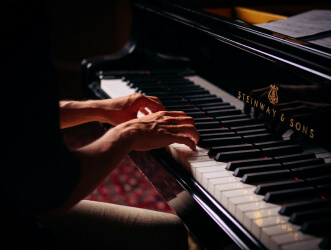
There was a lot of bargaining with the universe during that time. I promised I would stop working outside of music if I could just get my arm back. I promised I would do things differently. I promised I would listen.

Ironically, that year taught me more about music and musicianship than many years of relentless practice ever had.

Since I couldn’t physically play in the usual way, I turned to mental practice. I did everything I could to support my music that didn’t involve using my dominant hand. I spent a great deal of time working with just the head joint of my flute to maintain my embouchure. I listened more deeply. I studied scores. I imagined sound, phrasing, and movement.

And somewhere in the middle of all that, a very important realization emerged:
If I wanted to be the best musician I could be, I first had to be the healthiest person I could be.

That realization changed everything.

I began educating myself about somatic and movement-based approaches that support healthy, efficient use of the body. I studied the work of Moshe Feldenkrais and the Alexander Technique, both of which helped me understand how unnecessary tension was interfering with my playing. These methods didn’t ask me to push harder-they asked me to become more aware, more balanced, and more kind to myself.

I continued my yoga practice as well, but in a much more forgiving and flexible way. Instead of forcing shapes or chasing intensity, I focused on balance, ease, and breath. Incorporating disciplines that support aligned posture and supple musculature gave me a strong foundation-one from which sound, expression, and endurance could flow naturally.

Body Mapping was another eye-opening discovery. Understanding how the body is actually structured and designed to move, rather than how we think it works, made an enormous difference. The insights offered by Penelope Roskell, in particular, were invaluable in helping me translate anatomical knowledge directly into healthier, more effective playing.

I had always been mindful about nutrition, but during my recovery I became even more careful about what kind of fuel I put into my body. We truly are what we eat, and healing requires nourishment. I was especially grateful for a food processor gifted by a dear friend who worried I might starve if I couldn’t chop vegetables. She was probably right.

While I relied on excellent physicians to help me regain use of my arm, I also researched nontraditional and complementary methods to support their work. Even though this was many years ago, I was fortunate to find a neurologist who valued and incorporated these approaches into his practice. That combination of conventional medicine, movement education, and mindful selfcare ultimately made all the difference.

I’m happy to say that, by applying every tool available to me, I was able to return to a full career in performance and teaching.

But I also knew something else: if I wanted to maintain my performance health, I couldn’t treat this work as temporary rehabilitation. It had to become a way of life.

And it has.

Everything I learned during that injury continues to inform how I practice, perform, and teach. Healthy practice techniques are no longer optional extras—they are central to my approach. I incorporate them into every class I teach, because I believe musicians deserve longevity, freedom, and joy in their art.

My hope is that my students will never experience the kind of injury I did. Not because they are “lucky,” but because they are knowledgeable. Because they understand from the very beginning that pain is not proof of progress, and suffering is not a prerequisite for artistry.

No pain does not mean no gain.

No pain means freedom-the freedom to play with ease, expression, and sustainability for a lifetime.

Filed Under: Uncategorized

Do You Hear What I Hear? The Musician’s Guide to Hearing Preservation

pamelataylor

If you play an instrument and you aren’t actively protecting your hearing, the day may come when you simply can’t hear the music anymore.

For musicians, our ears are our most valuable equipment. They are more important than a Stradivarius, a vintage Les Paul, or a hand-crafted flute. Yet, while we spend thousands of dollars on gear maintenance and countless hours on technique, we often neglect the very biological sensors that make music possible.

In this guide, we’ll break down why your instrument might be a “silent” career-killer, the science of sound exposure, and how you can protect your livelihood without sacrificing the fidelity of your sound.

The Hidden Danger: Your Instrument vs. The World

Did you know that playing your instrument can often be louder than a passing subway car? We tend to think of hearing loss as something that happens to construction workers or frequent concert-goers, but for a musician, the danger is literal centimeters away.

Because instruments are held close to the head—a violin tucked under the chin, a flute held close to the right ear, or a trumpet bell projecting forward—the proximity increases the sound pressure level (SPL) significantly. This constant bombardment of high decibels doesn’t just cause “tired ears”; it can lead to permanent, irreversible damage.

Understanding the OSHA Standards

The Occupational Safety and Health Administration (OSHA) provides strict guidelines for noise exposure. Exceeding these limits can cause permanent physiological changes to the inner ear.

Duration Per Day (Hours)Sound Level (dBA)
890
495
2100
1105
0.5 (30 mins)110
0.25 (15 mins) or less115

As the volume increases by just a few decibels, the safe exposure time is cut in half. If you are a professional musician or a dedicated student practicing 4–6 hours a day, you are likely operating in a “danger zone” that you didn’t even know existed.

By the Numbers: How Loud is Your Music?

To understand the risk, you have to compare the OSHA standards to the actual output of common instruments. If you are putting in the hours necessary to become a professional artist, you might be courting disaster.

InstrumentAverage dB RangePeak Decibels
Violin / Viola (Near left
ear)
85–105116
Flute (Near right ear)98–114118
Piccolo (Near right ear)102–118126
Trumpet88–108113
Piano (Loud practice)70–105110
Symphonic Music86–102120-137
Percussion90–105123-134

Consider this: a subway train at 200 feet is approximately 95 dB. A flute or violin played at peak intensity is significantly louder than that train—and it’s sitting right against your body.

The Consequences: More Than Just “Going Deaf”

When we talk about hearing loss, most people imagine a world that just gets quieter. But for musicians, the symptoms of overexposure are far more insidious.

  • Tinnitus : This is the infamous “ringing in the ears.” It can be a constant highpitched whistle, a hum, or a roar. It is often permanent and can be physically and mentally exhausting.
  • Diplacusis (Pitch Distortion) : This is a musician’s worst nightmare. Overexposure can cause problems with perceived pitch. Can you imagine trying to play in tune in an ensemble if hearing damage causes you to hear a B flat when everyone else around you hears an A? Or worse yet, you might hear both a B flat and an A and not be able to sort which is correct!
  • Recruitment : This occurs when your brain compensates for hearing loss by making certain frequencies sound painfully loud and distorted.

If overexposure continues, the hair cells in your cochlea die. Once they are gone, they do not grow back. Your career, your hobby, and your passion have an expiration date if you don’t intervene.

The Solution: High-Fidelity Musician’s Earplugs

I spend many hours each day playing instruments in high-volume settings, yet my hearing remains sharp. Why? Because I treat hearing protection as a mandatory part of my “uniform.”

Many musicians avoid earplugs because they think of the cheap foam ones found at drugstores. Those “everything-sounds-like-mud” plugs are designed to block sound entirely, which ruins the musical experience.

Musician’s earplugs (Attenuators) are different. They are custom-molded to your ear canal by an audiologist and equipped with specialized filters.

Why Attenuators are Superior:

  • Flat Frequency Response : Unlike foam plugs that muffle high frequencies, these filters reduce the decibel level evenly across the entire spectrum. You hear the lows and highs exactly as they are, just quieter.
  • Clarity : Because the sound level is brought down to a healthy range, the natural distortion of your ear “overloading” is removed. You may actually hear the nuances of the music better than your unplugged colleagues!
  • Interchangeable Filters : You can swap filters based on your environment:
    • 9 dB Filters : Perfect for solo practice or acoustic chamber music.
    • 15 dB Filters : The “sweet spot” for most ensemble playing and orchestral work.
    • 25 dB Filters : Necessary for high-volume pits, drum corps, or amplified rock settings.

Action Steps: Protect Your Future Today

You wouldn’t skip oil changes for your car, so don’t skip “maintenance” for your ears. Here is how to get started:

1. Monitor Your Environment

Download a decibel meter app to see what your ears are actually dealing with. I recommend the NIOSH Sound Level Meter app. If you wear an Apple Watch, you can also have it notify you of exposure above any level that you set. Use it during your next rehearsal or practice session. You might be shocked to see the level jump into the danger zone of 105+ dB.

2. Visit an Audiologist

Make an appointment for a baseline hearing test and a fitting for custom plugs. Any qualified audiologist can help. You can ask your primary care provider who they recommend in your area. Be sure to ask for an audiologist who understands the specific needs of performers.

3. Practice with Protection

It takes a few sessions to get used to the feeling of earplugs. Start by wearing them during your individual practice sessions so your brain can adjust to the “new” volume level before you head into a high-stakes rehearsal. That way, you won’t find yourself overplaying to compensate.

Conclusion

The world of music is vibrant, loud, and beautiful-and we want to keep it that way for as long as possible. Don’t let a preventable injury cut your journey short. Invest in your hearing today so you can enjoy a long lifetime of making and hearing music.

Filed Under: Uncategorized

Are Plastic Nuvo Flutes Any Good? A Music Educator’s Perspective for Parents and Teachers

pamelataylor

If you have been following PTM for any length of time, you know that I tend to be very cautious about recommending instruments for young beginners-especially wind instruments. As a lifelong music educator, I’ve learned that parents are often searching for honest, experience-based answers to questions like “Is this instrument actually good for my child?” or “Is a plastic flute worth it?”

So, are plastic Nuvo flutes any good?

A while back, Ipurchased both the Nuvo jFlute and the Nuvo Toot. I had heard about these instruments for some time and was intrigued by their growing popularity among elementary music teachers and private instructors. More importantly, I wanted to see whether they could genuinely meet the physical and musical needs of my youngest students.

My Background with Young Flute Students

For thirty-one years, I worked as an early childhood music specialist while also running my private studio and performing professionally. Because of that background, I’ve always been comfortable accepting private students at a much younger age than many teachers would consider.

The challenge, however, has always been the instrument itself.

Even the Jupiter Prodigy, which is a wonderful beginner flute, proved to be too heavy and unwieldy for my smallest students. No matter how well designed, a traditional metal flute still requires a certain amount of arm length, hand strength, and postural stability. As a result, I often started very young children on piano, adding flute only when they reached the appropriate stature.

That’s where Nuvo caught my attention.

Enter Nuvo: Flutes Designed for Small Hands

Nuvo’s entire design philosophy centers on accessibility-lighter materials, smaller reaches, and student-friendly ergonomics. For parents and educators working with early elementary students, this is an important distinction.

Let’s take a closer look at each instrument.

The Nuvo jFlute

I began with the Nuvo jFlute, which is frequently marketed as a “first real flute” for young beginners.

Design and Ergonomics

The jFlute is extremely lightweight, which is a significant advantage for younger students who fatigue quickly. Instead of a traditional curved head joint, Nuvo uses a donut-style head joint, which makes the instrument much easier to balance.

Additional student-friendly features include:

  • Soft silicone contact points for the left index finger and right thumb
  • A built-in D-sharp key on the body
  • Optional key extensions to accommodate small hands

As students grow, the jFlute can evolve with them. A straight head joint and foot joint extension can be added later, allowing the instrument to reach the standard flute range.

Sound and Playability

I’ll admit I was pleasantly surprised by the tonal quality of the jFlute. Despite being plastic, it produces a sound with more depth and color than I expected. The scale is fairly consistent, and the third register is surprisingly responsive-something that will make a difference as the student develops.

The mechanism is a bit clickety-clack, but the key action is light and even. From a pedagogical standpoint, that’s a plus, as it helps encourage good finger habits without unnecessary tension.

The Firstnote Lip Plate

Nuvo includes a Firstnote lip plate, designed to make it easier for beginners to produce sound quickly. While I understand the intent, I was decidedly unimpressed.

Yes, it makes noise easier to produce-but at the expense of tone quality. In my experience, a competent teacher can guide a student to a clear, focused sound on a traditional lip plate very quickly. Using the Firstnote risks delaying proper embouchure development rather than supporting it.

Real-World Fit for Young Children

When the jFlute arrived, I showed it to one of my five-year-old piano students who had been expressing interest in the flute. Even with all its thoughtful design features, I found that the jFlute was still slightly too large for his small frame.

This is important: starting a child on an oversized instrument almost always leads to compensatory habits that are difficult to undo later.

Which brings us to the next option.

The Nuvo Toot

Nuvo clearly anticipated the need for something even smaller with the Nuvo Toot.

Size and Construction

The Toot is made from the same durable plastic as the jFlute but is one solid piece, making it extremely manageable for very young students. Even children with minimal coordination can hold it successfully.

Like a standard flute, the Toot is held transversely, which helps prepare students for eventual flute study.

Fingerings and Musical Transition

The Toot uses a hybrid fingering system that combines elements of both recorder and flute fingerings. When transitioning to the jFlute or a standard flute, there may be a brief adjustment period-but I don’t see that as a drawback.

In fact, learning that similar instruments can have different fingering systems is a valuable early musical lesson.

To make the instrument fully chromatic, the Toot includes two small plugs that allow access to C-sharp and D-sharp. Very young students may lack the fine motor skills to manage these holes reliably, but repertoire can easily be adjusted until they are ready.

Challenges to Be Aware Of

There are a few pedagogical concerns worth noting:

  • Covering the holes requires a fairly firm squeeze, which may encourage tension
  • The head joint is fixed, limiting flexibility in embouchure-hand alignment
  • The Firstnote lip plate is again included-and again, I would skip it

The Toot plays about one and a half octaves. While the first register is quite even, the second register is less reliable. I found the F-sharp to be notably sharp, requiring a significant embouchure adjustment. For students who need to remain on the Toot longer due to size, this could become an issue.

Final Thoughts: Are Nuvo Flutes Worth It?

Despite their limitations, I genuinely believe that both the Nuvo Toot and the Nuvo jFlute are excellent options for introducing young children to the flute.

From a parent’s perspective, the low cost is especially appealing. The Toot retails for around $36, and the jFlute for approximately $165. That’s a modest investment compared to traditional beginner flutes, and the durability alone makes them worth considering. These instruments can withstand drops, spills, and even a thorough bath-something parents of young children will appreciate.

From an educator’s standpoint, they provide a thoughtful bridge between musical curiosity and physical readiness.

For young families and teachers alike, Nuvo flutes offer a practical, low-risk way to engage a child at the moment their interest first sparks-and sometimes, that timing makes all the difference.

Filed Under: Uncategorized

Mastering the Keys: 5 Essential Strategies to Maximize Your Music Lessons

pamelataylor

Whether you are a beginner sitting down at the bench for the first time or an advanced student tackling the complexities of Rachmaninoff, the time you spend with your instructor is a precious commodity. As musicians, we often view the weekly lesson as the main event, but the reality is that the lesson is simply the spark; the fire is built during the rest of the week.

To bridge the gap between “just playing” and truly mastering your instrument, you need a strategic approach. Here are five professional-grade tips to ensure you get the highest value from every minute of your music lessons.

1. The Power of “Lesson Readiness”: Punctuality and Mindset

The first few minutes of a lesson are often the most vital. When you arrive prepared and mentally ready by the start of your scheduled time, you allow your brain to transition from the “noise” of the outside world into a creative headspace.

Computer folks call this “optimizing the user experience.” In the studio, this means:

  • Warm-up : If your studio allows, arrive five minutes early to stretch your fingers and settle your breathing.
  • Mental Checklist : Have a specific goal for the session. Are you struggling with a particular cadenza? Is your rhythm failing in the B-section? Identify these before the clock starts.
  • The “Transition” Ritual : Taking sixty seconds to silence your phone and take a deep breath ensures that you aren’t bringing the stress of traffic, work, or school into your musical phrasing.

2. Organizational Excellence: Your “Musical Toolkit”

Efficiency is the backbone of progress. Nothing kills the momentum of a great lesson like spending ten minutes searching for a lost notebook or a specific piece of sheet music.

I recommend a dedicated “Lesson Hub”—a high-quality backpack or tote bag used only for your music materials. This ensures you never leave home without:

  • Current Repertoire : All books and sheet music.
  • Assignment (in a notebook or on a device) : Your roadmap for the week.
  • Tools of the Trade : Pencils (never pens, unless they are Frixion Erasable Gel Pens), a metronome (or a calibrated app like Tonal Energy Tuner), and any necessary accessories like rosin, extra strings, or cleaning cloths and rods.

Pro Tip : In the digital age, many students use tablets for sheet music. Ensure your device is fully charged and your pedals are synced before you walk through the door. Being “ready to show off” your hard work requires having the tools to do so.

3. The Science of Practice: Scheduling for Success

One of the most common misconceptions in music education is that “more time equals more progress.” In reality, consistency beats intensity every single day.

Music is a physical discipline. You are training small muscle groups to perform highly specialized, non-intuitive movements. This is a process of myelination—building the neural pathways that create muscle memory. If you skip three days and try to “marathon practice” for three hours on a Saturday, you aren’t training your muscles; you’re straining them.

How to Schedule Like a Pro :

  • Treat Practice as an Appointment : Block it out in your digital calendar. If it’s not scheduled, it’s negotiable, and sometimes the draw of that TV show just might win out.
  • The 24-Hour Rule : Make every effort to practice within 24 hours of your lesson. This is when the instructor’s feedback is freshest in your “working memory.”
  • Quality Over Quantity : Twenty minutes of focused, goal-oriented practice is infinitely more valuable than an hour of mindless noodling.

4. The Support System: The Crucial Role of the “Music Parent”

For younger students, the bridge between the teacher’s studio and the home is the parent. A parent’s involvement is the single greatest predictor of a child’s long-term success in music.

However, “involvement” doesn’t mean being a “practice police officer.” Instead, think of yourself as a Musical Facilitator :

  • Active Listening : Ask your child to perform a “mini-concert” at the end of the week. Focus on the effort, not just the accuracy.
  • Shared Experiences : Take your child to live performances. Whether it’s a local jazz club, an outdoor music festival, or a symphony hall, seeing the “end result” of music education provides immense motivation.
  • Gamification : Use musical games or apps to reinforce theory. Make the home an environment where music is enjoyed, not just “worked on.”

5. The Consistency Principle: Why the “Bad Practice” Week Matters

Life happens. There will be weeks where the flu hits, school projects pile up, or work becomes overwhelming. Many students (and parents) feel the urge to cancel a lesson if they haven’t practiced “enough.” Some might even go so far as to quit lessons entirely!

This is a mistake.

Consistency is of the utmost importance. The lesson is not a recital; it is a laboratory. Even if you haven’t touched your instrument all week, that is the best time to go to your lesson. Why?

  • Guided Practice : Your teacher can show you how to practice more effectively when you’re busy.
  • Maintenance : A lesson prevents you from backsliding and helps maintain the “rhythm” of your musical life.
  • Goal Setting : Sometimes, the best lessons are spent talking about theory, listening to recordings, or adjusting techniques that don’t require 10 hours of prior practice.

By maintaining a steady schedule and arranging other appointments around your lesson time, you signal to yourself (and your brain) that your musical development is a priority. This discipline is where true mastery is born.

Final Thoughts

Music is a journey, not a destination. By showing up prepared, staying organized, practicing with intention, involving your support system, and prioritizing consistency, you aren’t just learning an instrument-you’re building a lifestyle of excellence.

Stay in touch with your passion, keep the communication lines open with your instructor, and most importantly, remember to bring the joy of music into your life every single day.

Filed Under: Uncategorized

Small Hands. Big Piano.

pamelataylor

What If Your Musical Instrument Does Not Fit Your Body?

In the world of professional music, there is a quiet, persistent myth: if you can’t reach the notes, you simply aren’t practicing hard enough. We are taught to stretch, to strain, and to “adapt” our physiology to the instrument. But as someone who has navigated the intersection of pedagogy and performance for decades, I have to ask: What if the instrument is the problem, not your body?

Years ago, I shared the story of my custom-made flute. As a musician with small hands and notably short fifth fingers, the standard flute layout was a constant source of tension. I found a specialized maker who redesigned the keywork to accommodate my reach. It changed everything. My technique became fluid, and the chronic fatigue in my hands vanished.

But for us pianists, the challenge is exponentially greater. You can’t simply tuck a 9-foot Steinway under your arm and take it to a boutique technician for a “re-keying.” If you asked a major manufacturer like Yamaha to build a bespoke instrument scaled to your hand span, the cost would be astronomical-well beyond the reach of most educators and performers. And they probably wouldn’t do it, anyway.

For too long, we have accepted the “one-size-fits-all” piano keyboard as a universal law. But history and ergonomics tell a different story.

The Ergonomic Solution: 7/8 and DS Standard Keyboards

There is a revolutionary solution for pianists with limited reach: the 7/8 reduced-size piano keyboard (often referred to as the DS6.0 or DS5.5). These keyboards fit the musical equivalent of an octave into the physical space usually occupied by only seven keys on a conventional (DS6.5) keyboard.

I first encountered this concept in 1999. Dr. Carol Leone at Southern Methodist University (SMU) conducted a landmark study on the feasibility and function of these keyboards. When the results were published in a pedagogy journal I subscribed to, it felt like a revelation.

As a teacher, my mind immediately went to my younger students. How many injuries could we prevent if children weren’t forced to contort their developing hands to reach a basic octave? Personally, I thought of the “prohibitive” repertoire-would I finally be able to perform Debussy’s La cathédrale engloutie or the dense chords of Rachmaninoff without the looming fear of a repetitive strain injury?

How Does a Reduced-Size Keyboard Actually Work?

A common misconception is that you have to buy an entirely new, smaller piano. In reality, the 7/8 keyboard is a separate keyboard action that can be retrofitted or “slid” into an existing grand piano.

The engineering is fascinating: while the keys themselves are narrower, the action “splays” outward toward the back of the instrument to align perfectly with the standard string arrangement. This means a university or a concert hall could own one high-quality grand piano and simply swap the action depending on the performer’s hand size.

Does Switching Keyboards Confuse the Brain?

The number one question I hear from skeptics is: “Won’t I ruin my muscle memory for a ‘real’ piano?”

The research says no. Studies from SMU and the University of Nebraska-Lincoln involving everyone from “rank beginners” to elite professionals have shown that the transition is remarkably easy.

Think of it like a multi-instrumentalist:

  • Wind Players : A flutist switches to a piccolo or alto flute without losing their ability to play the C-flute.
  • String Players : Violins come in 1/2, 3/4, and 7/8 sizes to accommodate children’s needs. My friend’s professional life was changed for the better when she acquired an instrument that was more suited to her petite frame.
  • Drivers : You can drive a compact car and then switch to a large SUV; your brain recalibrates the spatial requirements within minutes.

In fact, many professionals in the studies noted that practicing on a smaller keyboard increased their stamina. By removing the physical strain of over-stretching, they could focus on the musicality and technical precision, which actually improved their performance when they returned to a conventional layout.

The Current State of Keyboard Advocacy: PASK and The DS Standard

If we want to see these keyboards in every conservatory and concert hall, we have to look to the work of PASK (Pianists for Alternatively Sized Keyboards). This global advocacy group is petitioning manufacturers to recognize that “standard” shouldn’t mean “only.”

The technical backbone of this movement is The DS Standard Foundation, located in Titusville, PA. The foundation grew out of the pioneering work of David Steinbuhler, an expert in computer science and engineering. He developed the technology to precision-manufacture these actions so they feel exactly like a world-class instrument, just… scaled.

The foundation’s mission is clear: “To set a standard for alternatively sized piano keyboards that is recognized globally, so that pianists may reach their full musical potential while avoiding injury.”

Breaking the Resistance in the Piano World

Despite the clear benefits, there remains a stubborn resistance in the piano world. There is a “purist” mentality that suggests if you can’t play the repertoire on a standard keyboard, you shouldn’t play it at all.

I find this stance increasingly outdated. We have reached a point where we must prioritize human health and musical expression over an arbitrary manufacturing standard set in the 19th century-a standard, by the way, that was largely designed for the hand spans of men.

The orchestral world has already embraced this. Brass and wind instruments are now being modified for musicians with all kinds of physical needs-including one-handed flutes and ergonomic saxophones. It is time the piano world joined them.

Final Thoughts: A Future of Inclusion

Imagine a world where a 10-year-old prodigy doesn’t develop tendonitis by age 15. Imagine a professional with “small” hands finally performing the concerto of their dreams without pain. By making 7/8 and 15/16 (DS6.0) keyboards available in studios and on stages, we aren’t “cheating.” We are leveling the playing field. Whether your hands are big or small, the goal of music is to communicate emotion and beauty. The instrument should be the vehicle for that communication, not a physical barrier.

Filed Under: Uncategorized

Primary Sidebar

Categories

Check Out What Classes We Offer

Jungle Music
Music is Fun
Junior Keys
Piano Keys
Piano Keys
(teen & adult)
Private Study

Then Follow Us on Social

©Pamela Taylor Music | Website by Webstuff

  • Home
  • About
  • Classes
    • Jungle Music
    • Music is Fun
    • Junior Keys
    • Piano Keys
    • Piano Keys (Teen & Adult)
    • Private Study
  • Videos
  • Testimonials
  • FAQ
  • Blog
  • Contact